
The State has another financial reserve called the Stabilisation Reserve Fund. The Stabilisation Reserve Fund was formed in 1997 and its initial size was EUR 45.2 million. The Stabilisation Reserve Fund has been used twice – during 1998 and 1999 EUR 17 million for funding the claims from a bankrupt bank (Eesti Maapank), and in 2009 EUR 224 million for funding the State’s budget during the financial crisis. On 13 April 2020, the Parliament authorised the deployment as needed of the full balance of the Stabilisation Reserve Fund (EUR 430 million) to cover costs stemming from the COVID-19 pandemic and to reduce related economic risks during 2020 and 2021. The Stabilisation Reserve Fund was not used to mitigate the COVID-19 crises.
The State Budget Act requires that the share of profits received from Eesti Pank (central bank) be transferred to the Stabilisation Reserve Fund each year, that investment returns are retained in the Fund and that other transfers to the Fund may be mandated by Parliament.
The Parliament decides when to deploy the Fund. It may only be used for:
- the reduction of economic risks;
- the prevention or mitigation of socio-economic crises;
- the resolution or prevention of an emergency situation, a state of emergency, a state of war or other extraordinary situation or a crisis with material effect, or performance of the obligations provided for in a collective self-defense agreement;
- the resolution and prevention of a financial crisis that may cause difficulties related to liquidity or solvency for financial institutions or significant disruptions in the payment and settlement systems.
The return of the Stabilisation Reserve Fund is measured against a benchmark, which consists of three parts – money market, bonds and exchange-traded funds, with the range of eligible assets and the principles of financial risk management of the Fund being defined by the Government. The money market and bond part of the benchmark for the Stabilisation Reserve Fund is derived from the interest rate of A- to AAA-rated Eurozone government bonds and short-term deposits, so that with 95% probability during the next three years the return of the benchmark is non-negative (i.e., that the assets do not lose nominal value). The interest rate risk of the money market and bond part of the Stabilisation Reserve Fund is measured on a Value-at-Risk basis, market risk is not taken on the part of the exchange-traded funds. An overview of the Stabilisation Reserve Funds’ investment principles and financial risk management can be found under financial risk management.
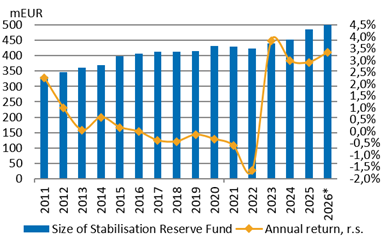
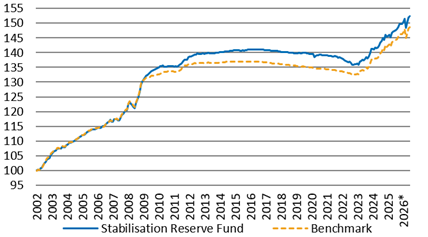
Investment reports for the Stabilisation Reserve Fund
Last updated: 06.08.2026
