
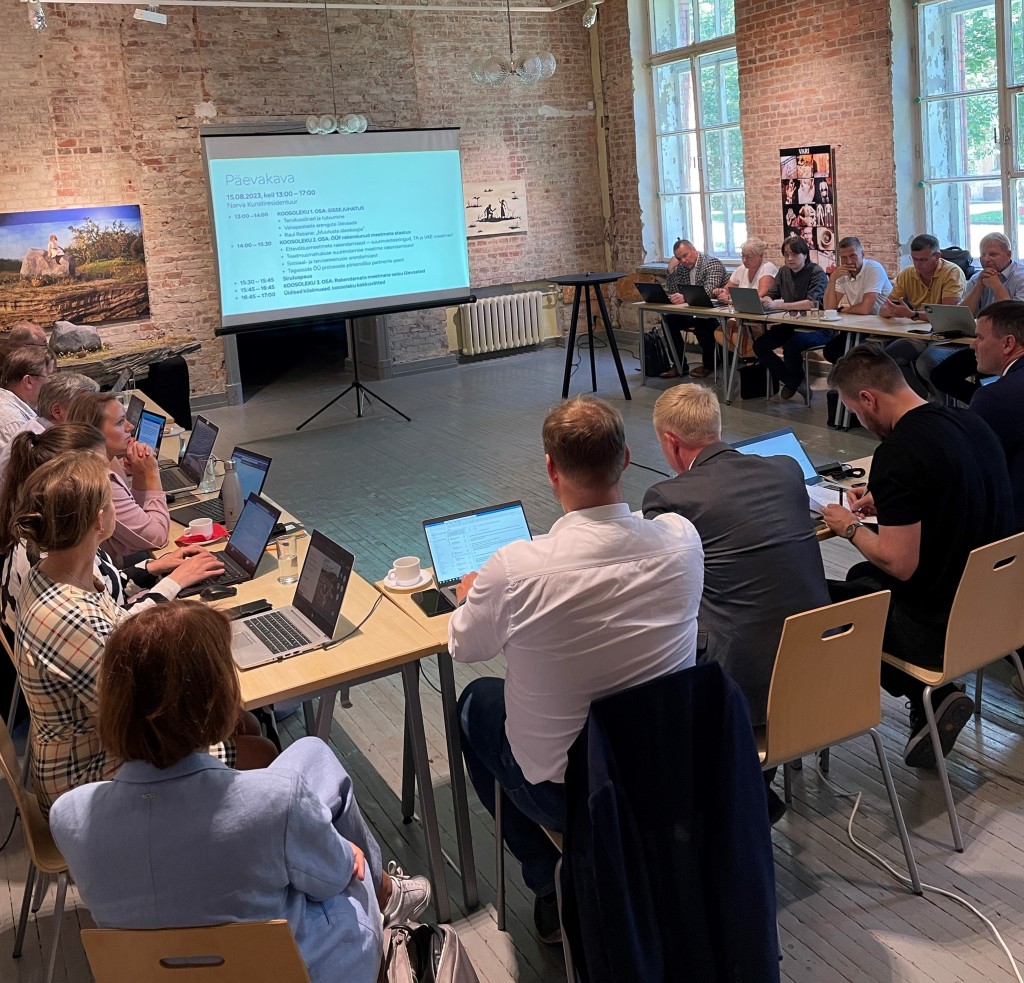
Five interventions of the Just Transition Fund (JTF) have been implemented to date, amounting to two thirds (ie 65%) of the fund’s total budget. All calls for proposals within interventions aimed at entrepreneurs are open, and the first supported project has reached the construction site. Among other things, the steering committee paid attention to the difficulties encountered in the implementation of the JTF, as the implementation of the fund has not been as fast as initially hoped due to inflation, Russia’s invasion of Ukraine and high interest rates.
The Just Transition Fund is an EU Cohesion Policy fund that totals 353 million euros and has a strong regional scope, helping Ida-Viru County to expedite its transition into a climate-neutral economic model. Following the recent reorganisation of the ministries, the JTF is managed in cooperation between the Ministry of Regional Affairs and Agriculture and the Ministry of Finance, the latter being responsible for the implementation and coordination of the fund, while the steering committee is headed by the minister of regional affairs.
At steering committee meeting, Minister of Finance Mart Võrklaev and Minister of Regional Affairs Madis Kallas met with the members of the committee, and further cooperation was discussed together. The meeting was also attended by regional organisations who had the opportunity to discuss with ministers the obstacles encountered in the implementation of the fund.
Minister of Finance Mart Võrklaev said that the Just Transition Fund provides a great opportunity to stimulate the economy of the region, and for entrepreneurs in Ida-Viru County – to create new jobs. Furthermore, it provides additional opportunities to the community to improve local life. “A good example is the magnet factory of NEO Performance Materials, the construction of which has begun and which is co-financed by the fund,” Võrklaev said. “Another excellent example is one of the largest employers in Narva – Fortaco –, a thriving company that is applying for funds to establish a new business unit.”
Võrklaev added that both the state and local level must work hard, since on the one hand, the funds are large and very necessary, but on the other hand, time is of the essence. “It is important for us to have capable entrepreneurs and local governments to use this money as wisely as possible to achieve future growth,” he said. “All the money invested will later make its way back to the state in the form of taxes and to people as income.”
Minister of Regional Affairs Madis Kallas said that the Just Transition Fund will allow Ida-Viru County to transition to a more sustainable economic model. “The COVID crisis and the war have made launching this process difficult, but it is great to see that activities have now begun in several areas,” Kallas said. “We will continue working with local governments to ensure that even more entrepreneurs can utilise the opportunities of the fund in the region and thus promote local life. I would like to thank all the representative organisations, local governments and other parties for their efforts so far.”
* The Just Transition Fund is a funding mechanism created by the European Union in order to enable regions and people to address the social, employment, economic and environmental impacts of the transition towards the Union’s 2030 targets for energy and climate and a climate-neutral economy of the Union by 2050, based on the Paris Agreement. Due to its dependence on the oil shale industry, the fund’s target region in Estonia is Ida-Viru County.

